Made with the help of AI from public curriculum standards, then checked. Mistakes can slip through, so please look it over before use. Found one? Tell us and we will fix it.
What's on the worksheet
Zoe has 4 toy cars. Zoe gets 2 more toy cars. How many toy cars does Zoe have now?
There are 6 leaves on the table. Owen takes 4 leaves. How many leaves are left on the table?
Sam has 3 balls. Sam gets 3 more balls. How many balls does Sam have now?
There are 9 flowers on the table. Owen takes 2 flowers. How many flowers are left on the table?
Skills practiced
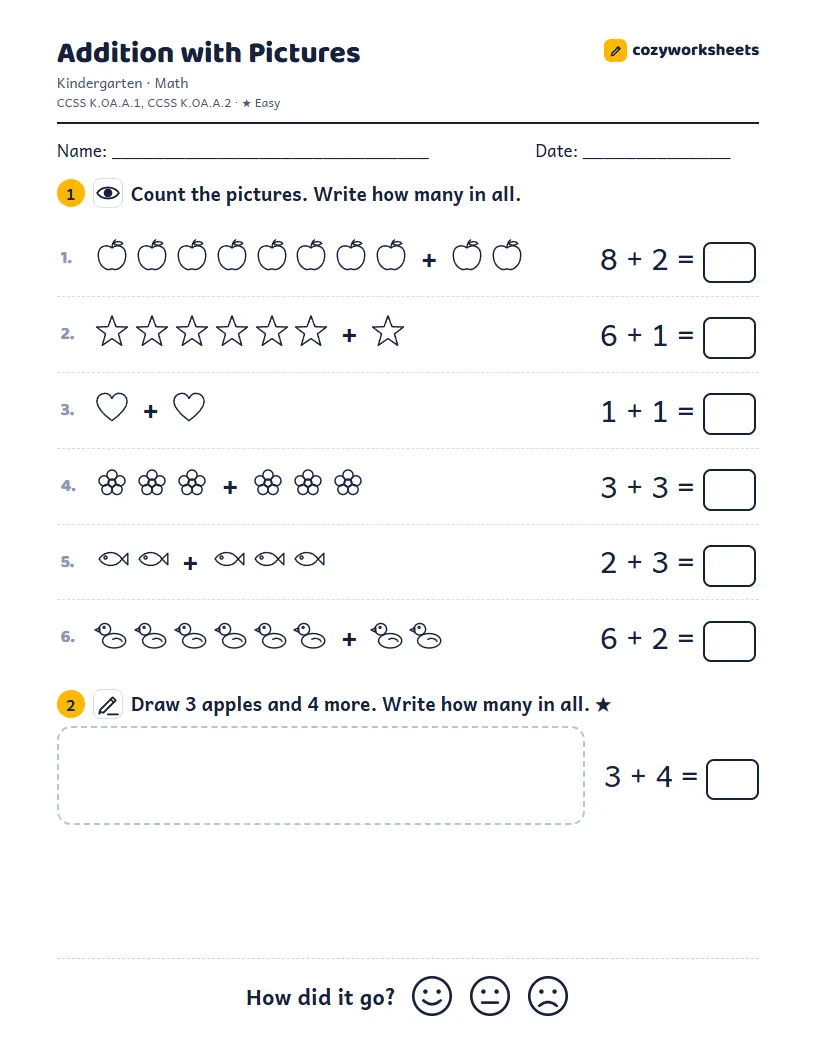
Each of the four problems is a short story that you read aloud: someone gets more, or someone takes some away. Pictures show the story, with the taken objects crossed out, so your child can count to find the answer before writing the equation. Kindergartners solve addition and subtraction story problems within 10 using objects and drawings, and this page shows how a story turns into numbers and a plus or minus sign. Two problems add and two subtract.
Common Core K.OA.A.2: Solving simple story problems that add or take away, up to 10
Common Core K.OA.A.1: Showing adding and taking away with fingers, objects, and drawings
Read the problem out loud (an adult reads for younger children).
Your child retells in their own words what happens in the story.
Write the number sentence, then solve it.
Write the answer as a sentence: Sam now has...
Tips for parents and teachers
Read each story slowly, then ask your child to tell it back in their own words. Ask: does the group get bigger or smaller? That one question usually decides between plus and minus. If your child writes the subtraction numbers in the wrong order, such as 3 − 8, point to the pictures: we start with all of them, then take some away.
Make it easier or harder
Easier: Act out each story with toys or snacks before looking at the page, and let your child say the equation while you write it down.
Harder: Ask your child to make up a new story for one of the equations, or to change one number in each problem and solve the new version.
Answer key
Show the answer key
Answer Key: Picture Word Problems
Kindergarten · Math
CCSS K.OA.A.2, CCSS K.OA.A.1 · ★★ Medium
cozyworksheets
The solutions.
1Zoe has 4 toy cars. Zoe gets 2 more toy cars. How many toy cars does Zoe have now?
+
4 + 2 = 6 · Zoe has 6 toy cars now.
2There are 6 leaves on the table. Owen takes 4 leaves. How many leaves are left on the table?
6 − 4 = 2 · There are 2 leaves left.
3Sam has 3 balls. Sam gets 3 more balls. How many balls does Sam have now?
+
3 + 3 = 6 · Sam has 6 balls now.
4There are 9 flowers on the table. Owen takes 2 flowers. How many flowers are left on the table?
9 − 2 = 7 · There are 7 flowers left.
More Kindergarten worksheets Scan the code or visit cozyworksheets.com/kindergarten/. Free, with answer keys.
It is made for Kindergarten (ages 5-6). The level is ★★ medium, so it suits children who already know the basics.
How long does it take?
About 15 minutes. Young children can do it in two short sittings with a break in between.
Where is the answer key?
On the second page of the PDF and on this page under Show the answer key. To print for a whole class, print only the first page of the PDF.
Which standard does it practice?
Common Core K.OA.A.2 (solving simple story problems that add or take away, up to 10); Common Core K.OA.A.1 (showing adding and taking away with fingers, objects, and drawings).
Can I use it in my classroom?
Yes. Print as many copies as you need for your own children or students. Please do not resell it or upload it to other websites.
Need a fresh version?The worksheet maker builds new pages with different numbers, mazes and tracing rows, plus versions A, B and C for a class.Open the worksheet maker