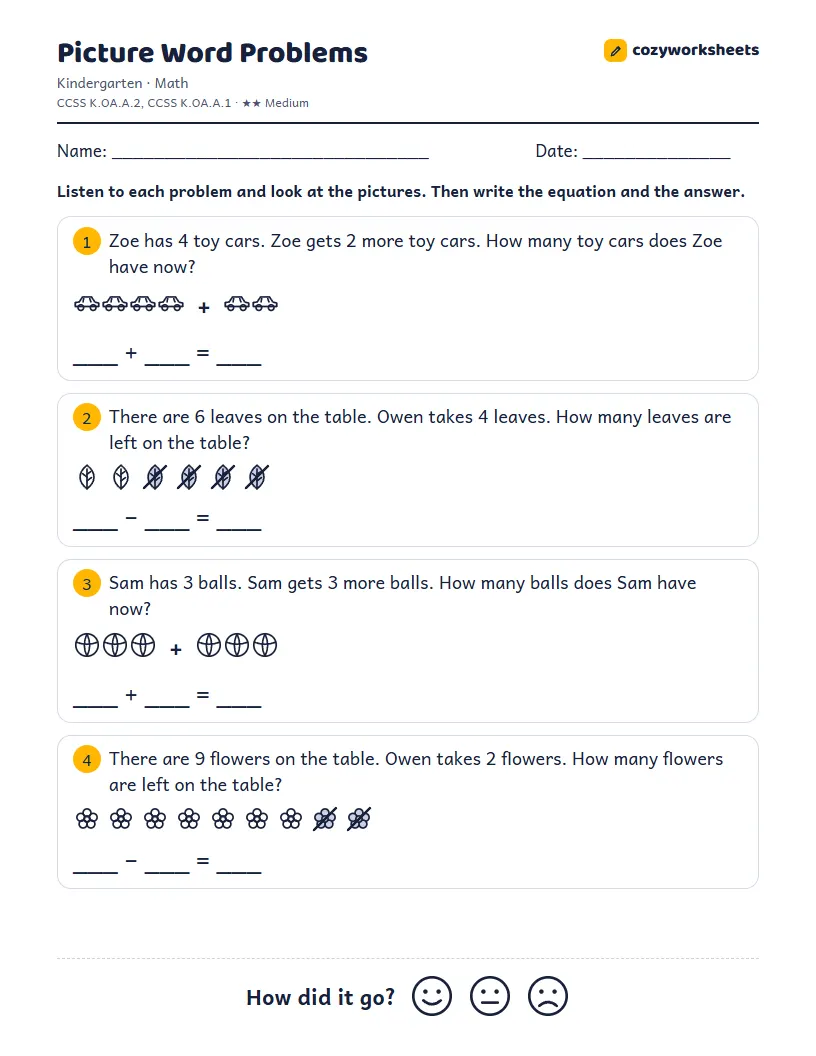
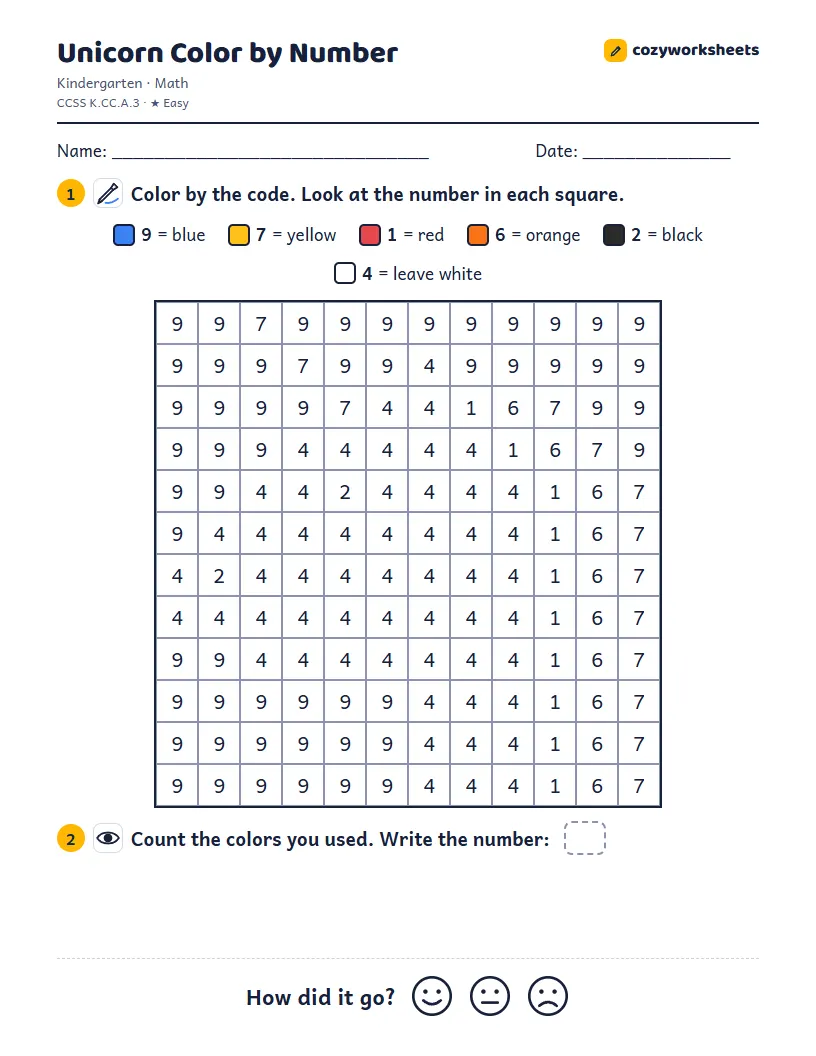
Made with the help of AI from public curriculum standards, then checked. Mistakes can slip through, so please look it over before use. Found one? Tell us and we will fix it.
What's on the worksheet
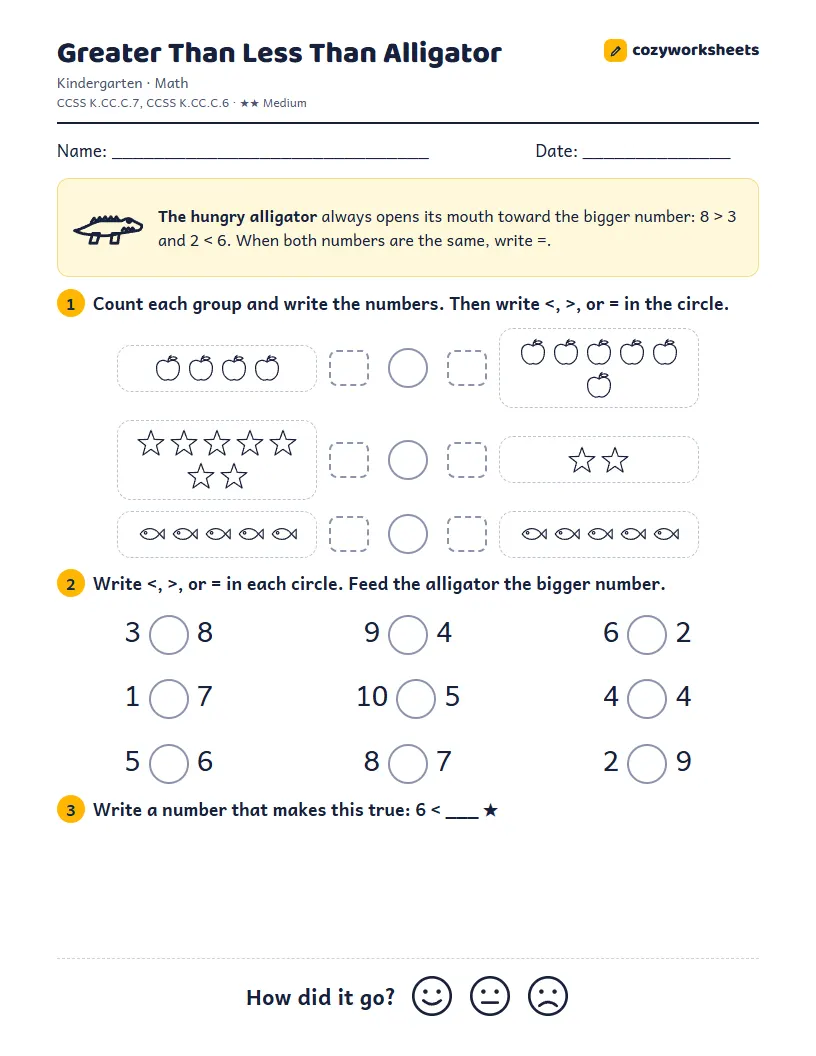
Count each group and write the number. Circle the group that has more.
Count each group and write the number. Circle the group that has fewer.
Circle the number that is more in each pair.
Skills practiced
Comparing amounts is a big kindergarten idea: does this group have more, fewer, or the same as that one? On this page your child counts two groups of pictures, writes how many are in each, and circles the group with more, then the group with fewer. A short last task compares written numbers with no pictures at all. Moving from pictures to numerals is the point: children learn that the number they write tells them which group is bigger, so they do not have to line up objects every time.
Common Core K.CC.C.6: Comparing two groups to see which has more, fewer, or the same
Your child reads the instruction out loud and explains in their own words what to do.
Work through the tasks in order: the first ones are easier and warm up for the next.
The task with a star is optional, for early finishers.
Check together with the answer key and redo only what was wrong.
Tips for parents and teachers
Have your child touch each picture while counting and write the number right away. If two groups look close, line up counters in two rows, one row for each group, and see which row is longer. Many children mix up more and fewer, partly because they rarely hear the word fewer. You can say: fewer means not as many. Everyday speech often uses less, and that is fine to mention too.
Make it easier or harder
Easier: Use only the first part and real objects: build both groups with blocks before your child looks at the pictures, and keep the numbers to 5.
Harder: Ask how many more the bigger group has in each row, or have your child draw a third group that has the same number as one of the others.
Answer key
Show the answer key
Answer Key: More or Less: Compare Groups
Kindergarten · Math
CCSS K.CC.C.6, CCSS K.CC.C.7 · ★ Easy
cozyworksheets
1Count each group and write the number. Circle the group that has more.
5
3
4
7
8
6
2Count each group and write the number. Circle the group that has fewer.
6
2
3
5
9
7
3Circle the number that is more in each pair.
479635108
More Kindergarten worksheets Scan the code or visit cozyworksheets.com/kindergarten/. Free, with answer keys.
It is made for Kindergarten (ages 5-6). The level is ★ easy, so it works well as a first practice page.
How long does it take?
About 15 minutes. Young children can do it in two short sittings with a break in between.
Where is the answer key?
On the second page of the PDF and on this page under Show the answer key. To print for a whole class, print only the first page of the PDF.
Which standard does it practice?
Common Core K.CC.C.6 (comparing two groups to see which has more, fewer, or the same); Common Core K.CC.C.7 (deciding which of two written numbers up to 10 is bigger).
Can I use it in my classroom?
Yes. Print as many copies as you need for your own children or students. Please do not resell it or upload it to other websites.
Need a fresh version?The worksheet maker builds new pages with different numbers, mazes and tracing rows, plus versions A, B and C for a class.Open the worksheet maker