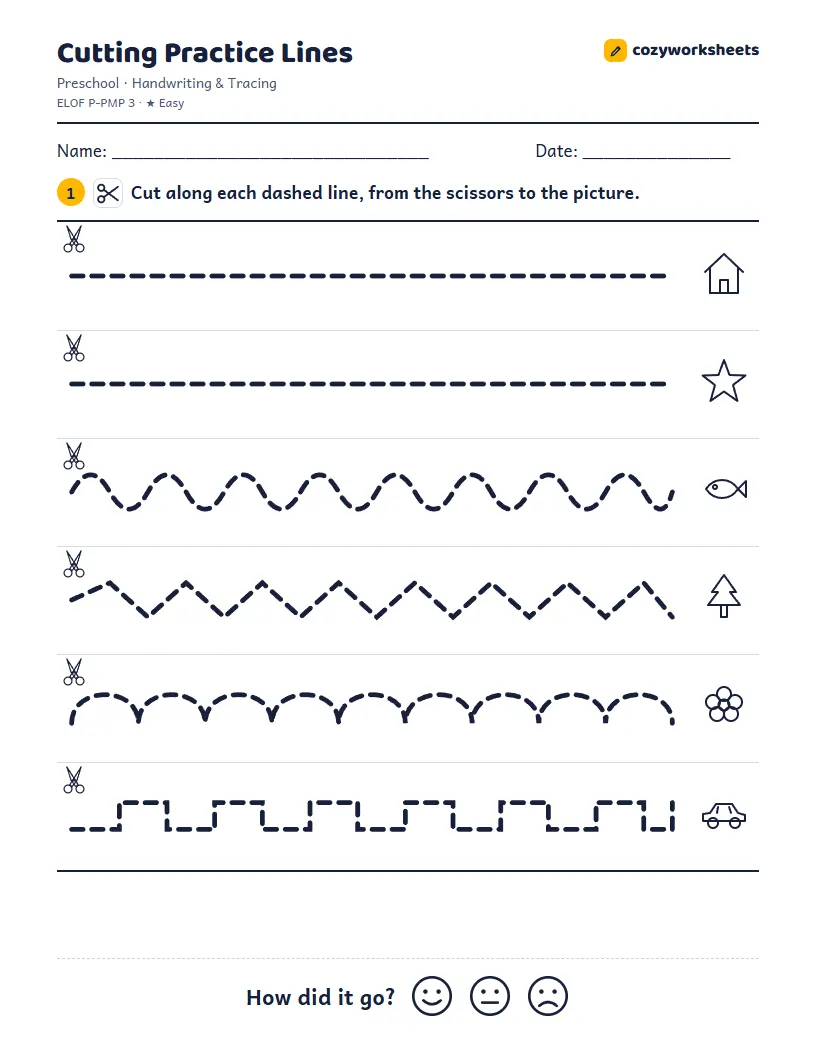
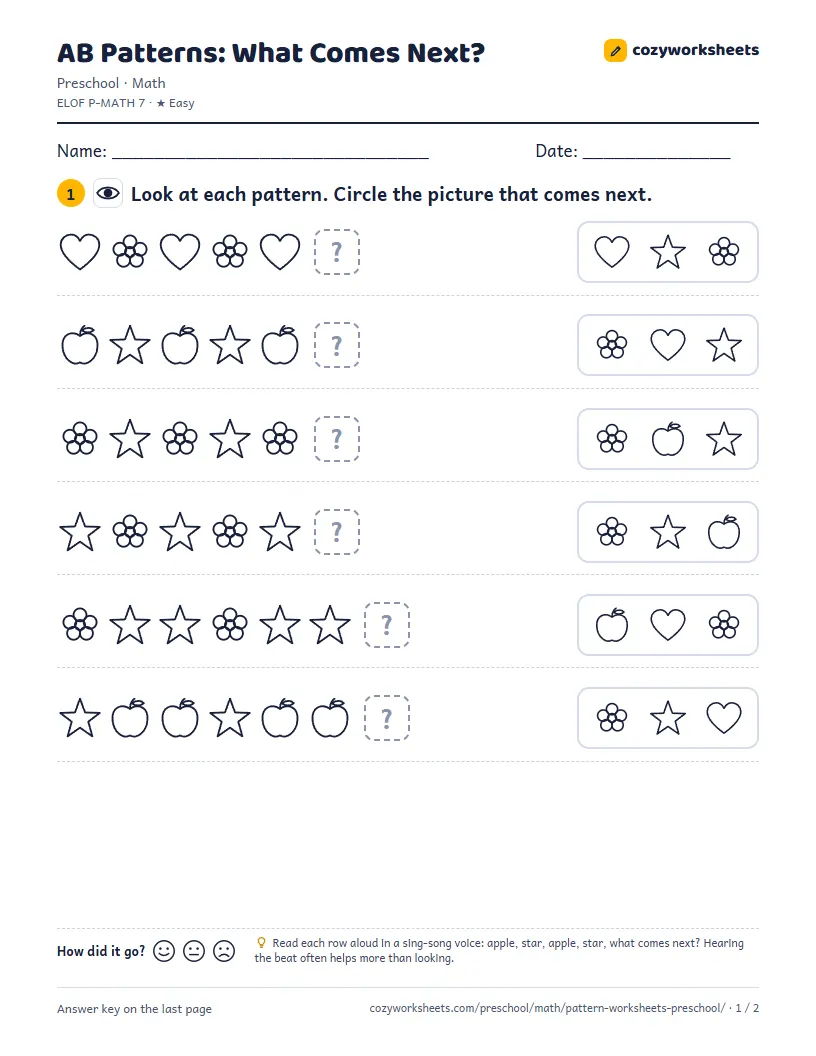
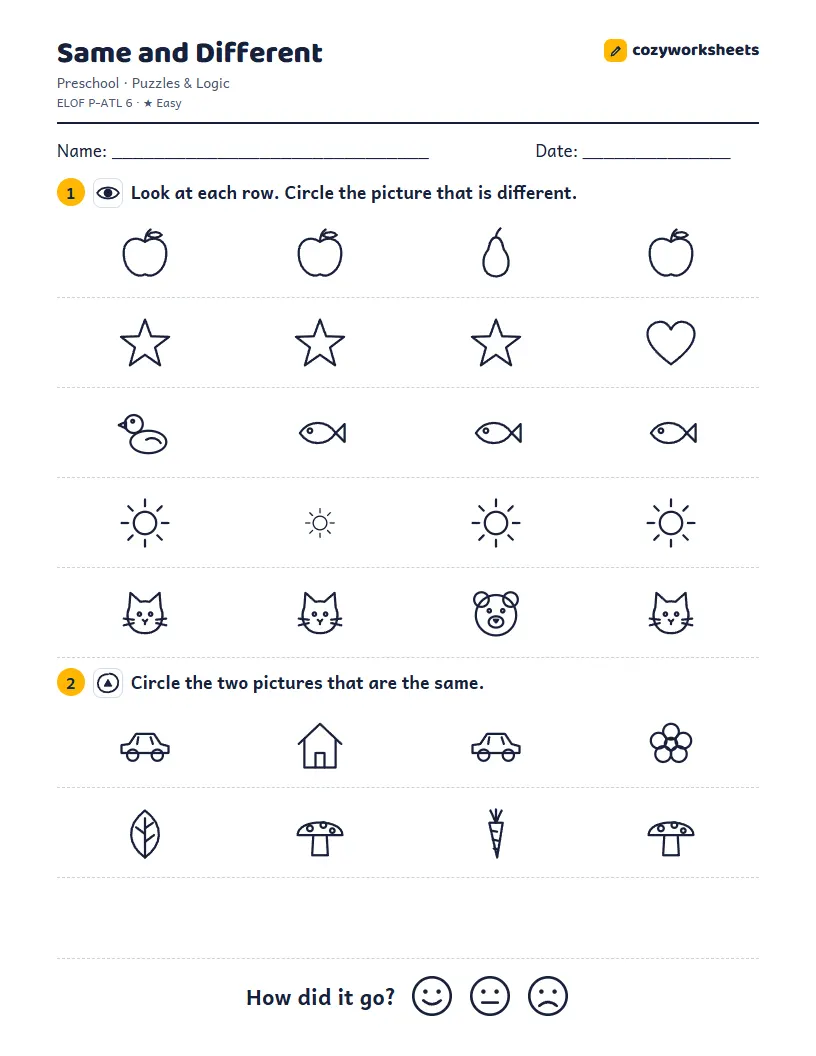
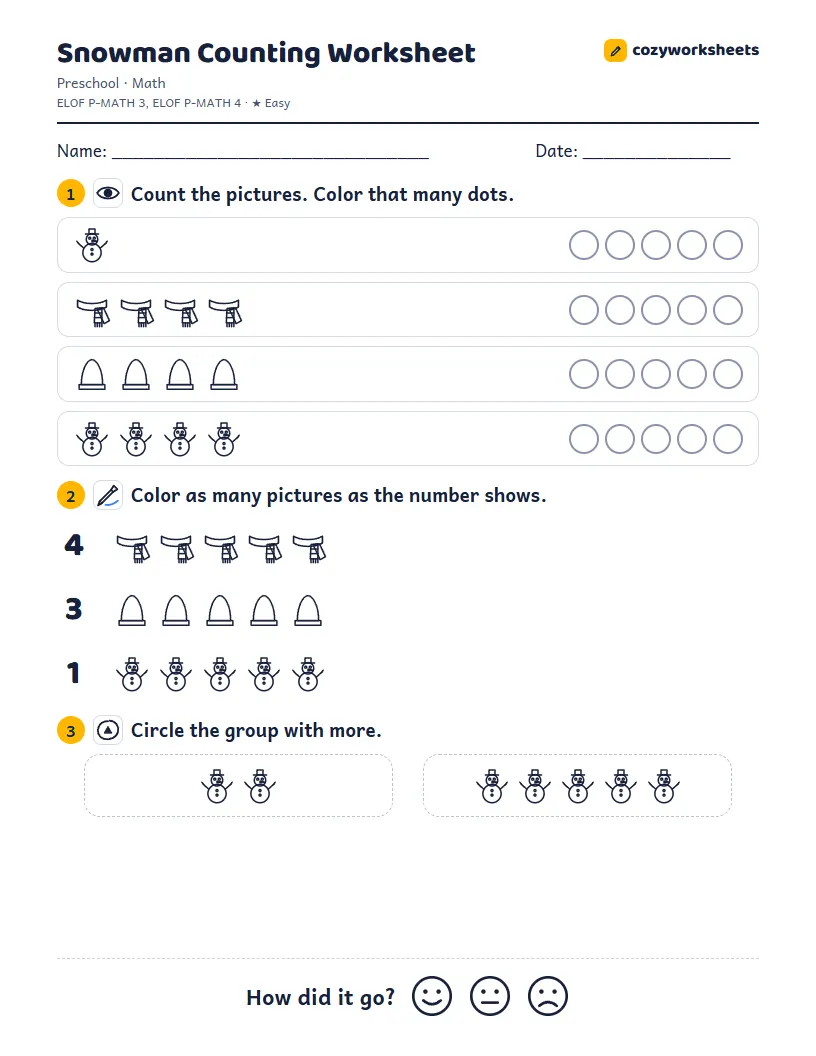
There is nothing to check on this page. What matters is that your child traces slowly along the dots, from left to right.
Practiced today: a straight line, waves, hills, a zigzag, loops, and steps. These are the same strokes that later make letters: straight lines for l and t, curves for c and s, zigzags for v and w.
Wobbly lines are normal at three and four. Take a short break between rows if little hands get tired.
More Preschool worksheets Scan the code or visit cozyworksheets.com/preschool/. Free, with answer keys.
Made with the help of AI from public curriculum standards, then checked. Mistakes can slip through, so please look it over before use. Found one? Tell us and we will fix it.
What's on the worksheet
Trace the dotted lines, from left to right.
Skills practiced
Each row on this page is a tiny winter story: bring the hat to the snowman, help the penguin swim to the fish, catch the snowflake with the mitten. Your child traces a dotted path from the picture on the left to the picture on the right. The six paths cover the basic strokes that later build letters and numbers: straight lines, waves, hills, zigzags, loops, and steps. Tracing from left to right also practices the direction we read and write in.
Head Start ELOF P-PMP 3: Building hand strength and control for holding pencils, cutting, and tracing
Your child reads the instruction out loud and explains in their own words what to do.
Work through the tasks in order: the first ones are easier and warm up for the next.
The task with a star is optional, for early finishers.
Check together with the answer key and redo only what was wrong.
Tips for parents and teachers
Read each little story aloud before your child traces that row. Show how to hold the crayon near the tip, with the paper steadied by the other hand. Speed is the most common problem: fast tracing wanders off the dots. Encourage your child to go slowly, like a snail, and to stop at the end picture. Thick crayons or markers are easier for small hands than thin pencils.
Make it easier or harder
Easier: Trace each path with a finger first, then with a crayon. Do the first three rows today and the rest another day.
Harder: Ask your child to trace each path twice in two colors, then draw a new wavy path between two winter pictures on the back.
Answer key
Show the answer key
Answer Key: Winter Tracing Lines
Preschool · Handwriting & Tracing
ELOF P-PMP 3 · ★ Easy
cozyworksheets
1Trace the dotted lines, from left to right.
There is nothing to check on this page. What matters is that your child traces slowly along the dots, from left to right.
Practiced today: a straight line, waves, hills, a zigzag, loops, and steps. These are the same strokes that later make letters: straight lines for l and t, curves for c and s, zigzags for v and w.
Wobbly lines are normal at three and four. Take a short break between rows if little hands get tired.
More Preschool worksheets Scan the code or visit cozyworksheets.com/preschool/. Free, with answer keys.
It is made for Preschool (ages 3-4). The level is ★ easy, so it works well as a first practice page.
How long does it take?
About 10 minutes. Young children can do it in two short sittings with a break in between.
Where is the answer key?
On the second page of the PDF and on this page under Show the answer key. To print for a whole class, print only the first page of the PDF.
Which standard does it practice?
Head Start ELOF P-PMP 3 (building hand strength and control for holding pencils, cutting, and tracing).
Can I use it in my classroom?
Yes. Print as many copies as you need for your own children or students. Please do not resell it or upload it to other websites.
Need a fresh version?The worksheet maker builds new pages with different numbers, mazes and tracing rows, plus versions A, B and C for a class.Open the worksheet maker